Restaurant Cutlery Stainless Steel Grades: A Buyer's Guide
Flip over a fork in any restaurant kitchen and you'll usually find a tiny stamp: 18/10, 18/0, or something similar. Most buyers glance past it, assume "stainless steel" is stainless steel, and order on price or looks alone. That's how a kitchen ends up with a drawer of pitted, spotted forks eighteen months after opening — and a supplier who can't explain why.
Those numbers aren't decoration. They tell you exactly how the cutlery will perform on your line: how well it resists your dishwasher's chemistry, how it will look after a thousand wash cycles, and how it feels in a guest's hand. This guide breaks down what the grades actually mean, why they matter more in Indian kitchens specifically, and how to buy cutlery that still looks good — and holds up — years in.
Decoding the Numbers: What 18/10 Really Means
The numbers stamped on flatware describe its alloy: the first number is the percentage of chromium, the second is the percentage of nickel.
- Chromium is what makes stainless steel "stainless." It reacts with oxygen to form an invisible, self-repairing protective layer on the surface, which is what resists rust and staining.
- Nickel doesn't add corrosion resistance on its own so much as it deepens and stabilises it — and it's what gives cutlery that bright, warm lustre rather than a flatter, greyish shine.
That's why the common grades perform so differently:
- 18/10 (18% chromium, 10% nickel) — the premium benchmark. Deep shine, excellent corrosion resistance, and a noticeably smoother, more substantial feel in hand. This is why fine-dining rooms default to it.
- 18/8 (18% chromium, 8% nickel) — very close to 18/10 in real-world performance. Most guests won't tell the difference across a table.
- 18/0 (18% chromium, virtually no nickel) — solid corrosion resistance from chromium alone, but a flatter shine that dulls a little faster. Because it lacks nickel, 18/0 is also magnetic — a quick fridge-magnet test on a sample is a fast way to sanity-check what a supplier is actually selling you.
- 13/0 (13% chromium, no nickel) — lower corrosion resistance, but it can be heat-treated to a harder edge. That's precisely why it's the standard choice for knife blades rather than full flatware: edge retention matters more than shine on a blade.
Grade Comparison at a Glance
| Grade | Composition | Corrosion Resistance | Feel & Cost | Best-Fit Venue |
|---|---|---|---|---|
| 18/10 | 18% chromium, 10% nickel | Excellent — nickel reinforces chromium's protective layer | Heaviest shine, smoothest feel; premium price point | Fine dining, 5-star hotels, flagship banquet covers |
| 18/8 | 18% chromium, 8% nickel | Very good — close to 18/10 in daily use | Slightly less depth of shine; mid-premium price | Upscale casual dining, boutique hotels |
| 18/0 | 18% chromium, ~0% nickel | Good — chromium alone, flatter shine over time | Lighter, magnetic, most economical of the three flatware grades | High-volume casual dining, cafés, staff and back-of-house cutlery |
| 13/0 | 13% chromium, ~0% nickel | Moderate — needs prompt drying to avoid spotting | Hardens well; built for edges, not shine | Steak knives and other blades, not general flatware |
You can browse graded flatware ranges directly on our cutlery collection page.
Why Grade Matters More in Indian Kitchens
"Stainless" means corrosion-resistant, not corrosion-proof — and Indian commercial kitchens put that resistance to the test harder than most. Hard water is common across large parts of the country, and mineral deposits from it show up as spotting on cutlery that isn't dried and polished promptly. High-chlorine sanitisers and salt-based rinse aids in commercial dishwashers, run cycle after cycle at high heat, gradually work on lower-chromium steel. Add a rushed dish pit during peak service, and thin, low-grade flatware starts pitting and dulling within months rather than years.
This is exactly where the grade you choose pays for itself. 18/10 and 18/8 shrug off this environment for years with only basic care. 18/0 holds up well too, but rewards a little more attentiveness at the drying station. Cheap, unmarked "stainless" cutlery with little real chromium content is where most rust and spotting complaints start.
Weight, Balance, and Forged vs Stamped
Grade tells you how the steel resists corrosion; how it's manufactured tells you how it feels in the hand.
- Forged cutlery is pressed from a single thick billet of steel, giving it more heft, a more consistent balance point, and a substantial feel that guests register the moment they pick it up.
- Stamped (pressed) cutlery is cut from rolled sheet steel — lighter, more economical, and faster to produce at volume. Quality stamped cutlery is a perfectly reasonable choice for casual and high-turnover formats; thin, cheaply stamped cutlery is where flatware starts to feel flimsy or front-heavy.
Balance matters as much as raw weight — a fork that feels front-heavy is something guests notice subconsciously over a long meal. Spec sheets can't tell you this; always handle a physical sample before committing to a bulk order.
Finish Options: Mirror, Satin, and Coloured PVD
Beyond grade and construction, finish is what actually sets the tone of your table.
- Mirror-polished is the classic, formal look — bright and reflective, but it also shows fingerprints and water spots most readily, so it demands more attentive polishing.
- Satin/matte (brushed) finishes are softer and more contemporary, and forgive the small scratches and minor spotting that commercial dishwashing inevitably causes — a big reason they've become popular across modern-casual and continental concepts.
- PVD-coated cutlery — finished in gold, rose gold, black or gunmetal tones through a physical vapour deposition process that bonds a thin, durable colour layer onto the base steel — has moved from niche to mainstream fast. It suits contemporary bars, boutique hotels, and photography-led restaurant concepts where the table setting is part of the brand.
One thing worth knowing before you order: a coloured finish sits on top of the base steel, it doesn't replace it, so the base grade is still what determines how the piece resists corrosion underneath the coating. Among the lines we carry, Metinox offers gold and copper-tone PVD cutlery built specifically for this kind of table styling, alongside its standard steel finishes.
What a Standard Place Setting Needs
A full cover is more than a fork and a knife. Most Indian full-service restaurants work off some version of this list:
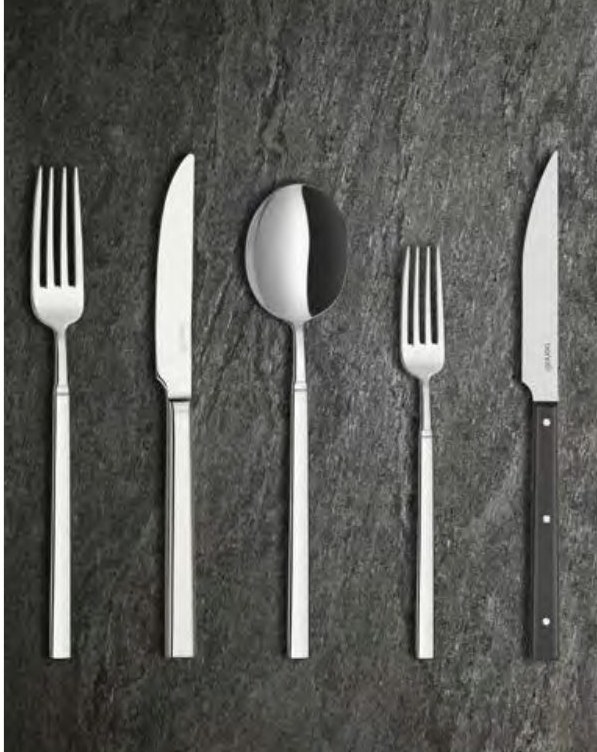
- Table fork and table knife — the core of every cover.
- Dessert or starter fork and spoon — for smaller courses.
- Tea/coffee spoon — the highest-use, easiest-to-lose piece; order generously.
- Soup spoon — essential wherever the menu includes soups, dals, or curries served in bowls.
- Steak knife — a specialty piece, added where the menu calls for it rather than stocked for every cover.
- Serving pieces — serving spoons, ladles, and servers, which Indian multi-cuisine and shared-plate dining leans on more heavily than a-la-carte Western formats.
You'll find the full range of place-setting pieces and serving cutlery in our cutlery collection, alongside the rest of our tableware collections.
Buying in Bulk: Par Levels, Patterns, and Care
- Plan for loss, not just covers. Cutlery is bussed away, scraped into bins, and walks off in buffet and banquet settings more than any other tableware category. Order well beyond your bare seats-times-turns math, and treat that buffer as an ongoing reorder rather than a one-time cushion.
- Standardise on one pattern. Once you settle on a line, stay with it — a table where forks and spoons don't visually match reads as an oversight, not a style choice, and it makes future reordering far simpler.
- Buy open stock. Source cutlery as individually reorderable open stock rather than fixed boxed sets, so you can top up exactly what's missing — usually teaspoons and dessert forks first — without over-buying whole sets.
- Care for the dishwasher cycle. Scrape off food residue, especially salt and acidic sauces, before racking rather than letting it sit. Don't overload racks so pieces nest and touch. Dry and polish promptly rather than air-drying in a closed drawer, and avoid washing stainless cutlery in the same load as silver items — the two metals can react and pit each other.
- Going custom. If you want a monogrammed handle, a branded pattern, or a fully bespoke line for a flagship property, we also handle custom and branded cutlery orders.
Ready to spec out your cutlery order? Share your cover count, service style, and preferred grade or finish, and we'll put together a wholesale quote across patterns. Reach us via /contact or WhatsApp us directly at +91 95152 27616.
Frequently Asked Questions
Sourcing tableware for your venue in Bangalore?
Browse 11,000+ pieces across 12 premium brands, or send us your list for a wholesale quote.