Chafing Dishes & Buffetware: A Guide for Hotels & Caterers
Heat retention makes or breaks a buffet line. Food that looks perfect on the pass can turn lukewarm or unsafe within twenty minutes if the setup is wrong — the wrong fuel, an undersized chafer, or a lid left open too long. Chafing dishes are also one of the most under-specified purchases in Indian hospitality: many properties buy whatever the local vendor stocks, then discover mid-service that pans don't interchange or fuel runs out.
This guide covers how a chafing dish works, the main chafer types and heat sources, how Gastronorm (GN) pan sizing works, and how to plan quantities and the wider buffet kit around it.
What Is a Chafing Dish, and How Does It Keep Food Warm?
A chafing dish works on a principle borrowed from classic kitchen technique: the bain-marie, or water bath. A shallow water pan sits above a heat source, a food pan holding the dish sits in or above that water, and a domed lid traps heat over the top — spreading it gently and evenly, without a direct flame or element ever touching the food.
This indirect heating holds food above the range where bacteria multiply quickly, without continuing to cook it — so curry or steamed rice stays food-safe and appetising through hours of service instead of drying out or scorching at the edges. Get the water level and heat source right, and a good chafer holds food evenly from the first guest to the last.
Chafer Types: Matching the Style to Your Service
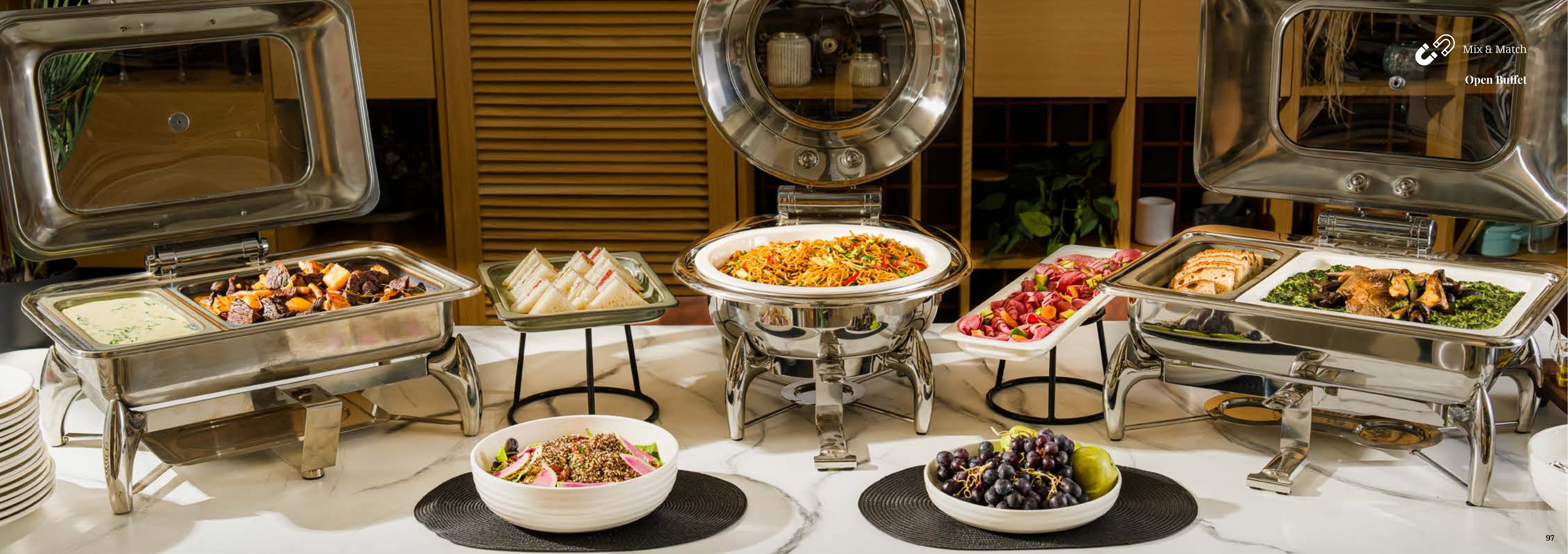
Not every buffet line needs the same chafer. The main choices are lid mechanism, shape and size, and finish:
- Lift-top — a hinged or removable lid, lifted by hand. Lowest cost and lightest to move; fine for smaller, closely staffed counters.
- Roll-top / hydraulic — the lid rolls back on a hydraulic arm and locks open, freeing both hands to serve. Better heat retention and a more polished look for high-visibility counters.
- Round vs rectangular vs square — rectangular is standard for mains and rice, matching full/half GN pans. Round suits soups and single showpiece dishes. Square suits corner or island counters.
- Glass-lid induction vs classic stainless — glass-domed induction units show off the dish while heating electrically; striking but pricier and power-dependent. Classic stainless is the durable, easy-clean daily workhorse.
| Chafer Type / Size | Typical Capacity | Best Use |
|---|---|---|
| Full-size rectangular (1/1 GN) | One full GN pan | Mains, curries, rice — the standard workhorse |
| Half-size rectangular (1/2 GN) | One half GN pan | Smaller functions, side dishes |
| Round chafer | Round pot or inset | Soups, stews, dals, showpiece dishes |
| Square chafer | Comparable to full/half-size | Corner or island counters |
| Glass-lid induction | Usually full or half GN | Premium live counters, show-cooking |
Choosing a Heat Source: Gel Fuel, Electric, or Induction
The heat source affects running cost, safety, and indoor air quality as much as it affects how evenly food stays warm:
- Gel or ethanol fuel — a wick-free gel canister burning with a low, steady flame. No power point needed, the default for outdoor events and venues without reliable power.
- Electric — a thermostatic element replaces the open flame, plugged into a standard socket. No naked flame indoors and steadier control, but every station needs a power point.
- Induction — an induction base heats the water pan directly and efficiently. Fast, precise, and flame-free, but the highest upfront cost and most power-dependent of the three.
| Heat Source | Pros | Cons | Best For |
|---|---|---|---|
| Gel / ethanol fuel | No power needed; portable; low upfront cost | Recurring canister cost; open flame needs ventilation | Outdoor events, marquees, no-power venues |
| Electric | No open flame; steady, controllable heat | Needs a power point per station; no backup in a cut | Indoor banquet halls, fixed counters |
| Induction | Fast, precise, flame-free, premium look | Highest upfront cost; fully power-dependent | Premium live counters, show-cooking |
Ventilation matters indoors as much as fuel choice. Gel fuel burns clean but is still an open flame, so keep it clear of drapes, and never refuel a lit chafer. Electric and induction sidestep the open-flame question, which is why many hotels default to electric indoors and keep gel fuel for offsite catering.
Understanding GN (Gastronorm) Pan Sizes
Gastronorm, or GN, is the international sizing standard behind almost every chafer, bain-marie, and hot-cupboard. The full-size 1/1 GN pan is the reference footprint, and every other size is a fraction of it:
- 1/1 — full size, the reference footprint every chafer well is built around.
- 1/2 — half of a 1/1, for smaller-volume dishes or side items.
- 1/3 — a third of a 1/1; three fit inside a full-size well.
- 1/4, 1/6, 1/9 — progressively smaller inserts for garnishes and sauces.
Depth varies too, from shallow (garnishes) to deep (curries, dal, rice), matched to how much of a dish you go through per sitting.
Standardisation is what makes GN sizing useful: pans and inserts from different ranges are interchangeable inside the same chafer, so you can mix dish sizes, swap a near-empty pan mid-service, and reorder spares without hunting for one supplier's proprietary shape.
The Buffet Kit Beyond the Chafer
A chafing dish rarely works alone. A well-run buffet line is a coordinated kit, and the same durability and interchangeability logic applies to everything around it:
- Display risers and tiers — height and separation for salads, desserts, and garnish-led dishes.
- Serving platters and bowls — for cold, ambient items: salads, breads, chutneys, cut fruit.
- Soup stations and tureens — built for ladling soup safely, without a shallow pan's spill risk.
- Beverage dispensers — for juices, infused water, and mocktails on self-service counters.
- Tongs and serving cutlery — dedicated to each dish, in a finish that matches the rest of the line.
- Sneeze guards — increasingly expected, and often required, over any self-service counter.
Sourcing these as a coordinated range, not piecemeal, is what makes a buffet line look considered rather than assembled last-minute — exactly what we help hotels and caterers put together across our buffetware & serveware range.
How Many Chafers Do You Need? A Practical Rule of Thumb
Chafer quantity is one of the most common planning questions we get, and while the honest answer is "it depends on your menu," a few rules of thumb help:
- One full-size chafer per dish comfortably serves roughly 40-50 guests in a typical multi-dish Indian buffet — four to six mains plus rice, dal, and accompaniments — at normal portioning.
- If a dish is the centrepiece, such as a hero biryani or live-counter special, plan closer to 25-30 guests per chafer, since turnover runs higher.
- Scale by number of live counters, not guest count alone. A 300-cover wedding with five counters (mains, biryani, a live grill, a soup station, dessert) needs chafers sized to each counter's footfall.
- Build in one spare pan per counter, so it can be swapped and refilled without a gap in service.
Treat these as a starting point, not a formula — it depends heavily on menu and turnover. Share your guest count via /contact and we'll help size the counters.
Buying for Daily Banquet Use: What Actually Matters
Chafers see more daily wear than almost anything else in a banquet kitchen — repeated heating, stacking, transport, and hard institutional dishwashing. A few things separate a chafer that lasts for years from one that looks tired within a season:
- Durability of finish. Heavier-gauge stainless and a polish that resists water spotting — thin, budget stainless dents and discolours fast.
- Interchangeable GN pans. Choose chafers that take standard GN inserts, not a proprietary pan shape, so spares stay easy to source.
- Easy cleaning. Removable water pans and dishwasher-safe inserts save staff time on a busy turnover.
- Storage and stacking. Frames that nest or stack cleanly save back-of-house space.
- A coordinated range from one supplier. Chafers, risers, platters, and cutlery from a single source keep the finish consistent and reordering simple.
See the full spread in our buffetware & serveware range, alongside the rest of our collections.
Whether you're setting up a new banquet hall, adding live counters, or replacing chafers past their working life, we can help you size the right mix of chafers, heat sources, and GN pans for your covers. Request a wholesale quote or message us on WhatsApp at +91 95152 27616 — we'll help you build a buffet setup for daily service, not just the photo.
Frequently Asked Questions
Sourcing tableware for your venue in Bangalore?
Browse 11,000+ pieces across 12 premium brands, or send us your list for a wholesale quote.