Gastronorm (GN) Pan Sizes Explained: The Standard That Runs a Professional Kitchen
If you have ever wondered why one supplier's pan drops cleanly into another supplier's chafing dish, bain-marie or under-counter fridge, the answer is Gastronorm. GN is the quiet standard that lets a professional kitchen run like a system rather than a collection of odd trays. Get it right and prep, holding, transport and service all speak the same language. Get it wrong and you end up with pans that don't nest, lids that don't seal and a buffet line full of improvised gaps. This guide explains the GN sizes, depths and materials clearly, so you can specify the right pans the first time.
What is Gastronorm (GN)?
Gastronorm is a European standard (defined in EN 631, and historically linked to DIN 66075) that fixes the outer dimensions of food pans, containers and the equipment that holds them. Because the footprint is standardised, a GN pan made by any reputable manufacturer will fit any GN-compatible chafing dish, hot cupboard, salamander tray, refrigerated prep well or transport trolley. It is the tableware equivalent of a shipping container: the outside is always the same, so nobody has to argue about whether it will fit.
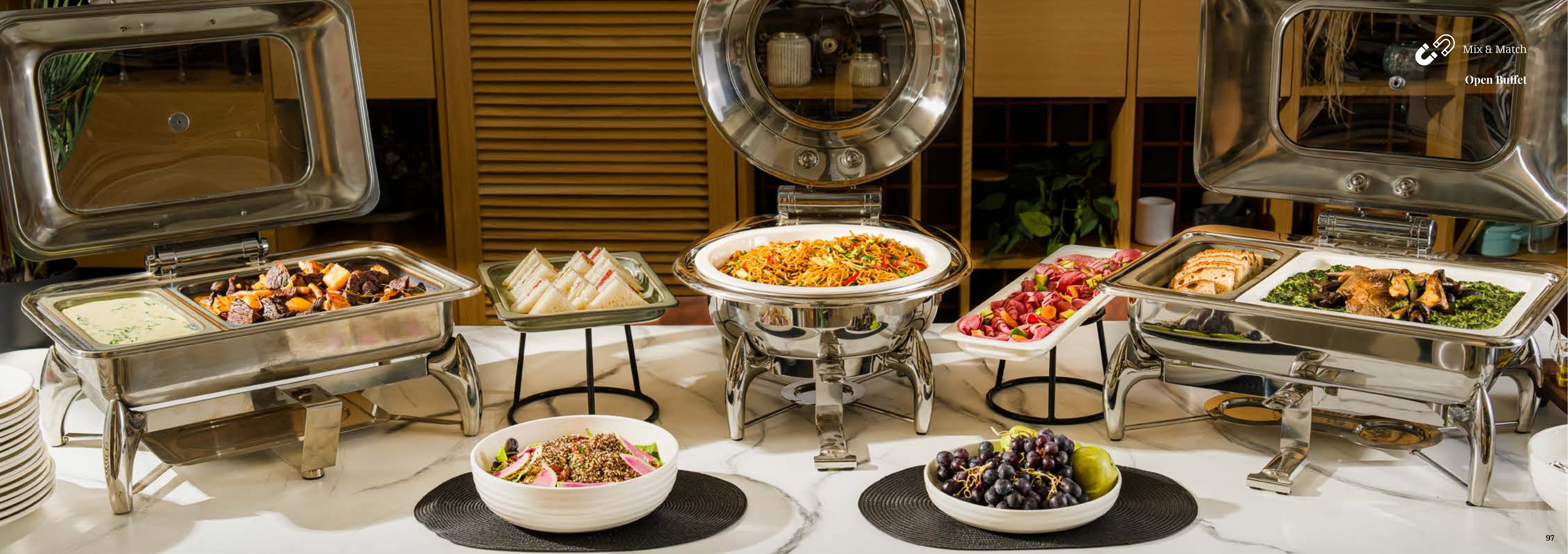
That interchangeability is the whole point. A kitchen might prep in a polycarbonate GN container in the fridge, transfer the food into a stainless GN pan for the salamander, then carry the same pan to a bain-marie or a chafer on the buffet — no decanting, no wrong-sized trays, no wasted counter space.
Why standardisation matters
For an F&B or purchase manager, GN removes guesswork from procurement. You can buy chafing dishes from one line and pans from another and know they will mate. You can add capacity next season without re-buying your holding equipment. Spares and lids are easy to source because everyone works to the same grid.
It also protects your buffet's appearance. When every insert shares an outer dimension, a counter reads as a clean, continuous line rather than a patchwork — which matters as much for a hotel breakfast spread as it does for banquet service.
The GN size system
Every GN size is a fraction of one full-size pan. The base unit is GN 1/1, with an outer footprint of roughly 530 x 325 mm. Every other size is derived by dividing that footprint — halves, thirds, quarters and so on — so smaller pans combine to fill the same opening as a 1/1.
The fractions describe how pans tile together to fill a full-size opening, not a literal halving of both edges — which is why the outer dimensions aren't always what you would expect. A 1/2 and a 1/3, for instance, both share the 325 mm short edge of a 1/1 and simply divide its length, while smaller fractions subdivide those in turn. In practice you don't need the geometry — you need to know which sizes combine to fill a 1/1, which the table below makes clear.
| GN size | Approx. outer dimensions (mm) | Fits within | Typical use |
|---|---|---|---|
| 2/1 | 650 x 530 | Double 1/1 opening | Large banquet & bulk holding |
| 1/1 | 530 x 325 | Full opening | Full-size chafers, mains, bain-marie |
| 2/3 | 354 x 325 | 1/1 | Sides, curries, rice |
| 1/2 | 325 x 265 | 1/1 | Vegetables, gravies, desserts |
| 1/3 | 325 x 176 | 1/1 (three across) | Sauces, sides, cold garnishes |
| 1/4 | 265 x 162 | 1/2 | Toppings, pickles, condiments |
| 1/6 | 176 x 162 | 1/3 | Dressings, chopped garnish |
| 1/9 | 176 x 108 | 1/3 (three across) | Small condiments, sauces, sambals |
A quick rule of thumb: two 1/2 pans, three 1/3 pans, or a mix (say one 1/2 plus two 1/4s) all fill a single 1/1 opening. That's what lets you build a flexible salad bar, a raita-and-chutney station or a live counter inside standard equipment.
Standard GN depths (and what they hold)
Every footprint comes in a range of depths, quoted in millimetres. The common steps are 20, 40, 65, 100, 150 and 200 mm. Depth is where capacity lives, so pairing the right depth with the right footprint is how you match volume to demand without over-buying.
| Depth | Best for | Notes |
|---|---|---|
| 20 mm | Garnishes, flat display | Shallow; drains and cleans fast |
| 40 mm | Dry sides, grilled items | Good for salamander & display |
| 65 mm | Everyday mains & sides | The workhorse depth for most lines |
| 100 mm | Curries, gravies, rice | Strong volume-to-footprint ratio |
| 150 mm | High-volume banquet holding | Heavier; plan lifting & handling |
| 200 mm | Bulk stock, soups, dal | Maximum capacity; check equipment clearance |
Two practical points. First, deeper isn't automatically better — a deep pan of a delicate item sits at the bottom of the well and dries or scorches while the top looks empty. Second, always confirm the depth clears your chafer lid or fridge shelf before ordering, especially at 150 mm and 200 mm.
Stainless steel vs polycarbonate
Both materials share the GN footprint, so they're interchangeable in the grid — you choose by where the pan works in your flow.
| Feature | Stainless steel | Polycarbonate |
|---|---|---|
| Heat holding | Excellent — chafers, bain-marie, salamander | Not for direct heat |
| Cold / storage | Good | Excellent — fridge, prep, transport |
| Visibility | Opaque | Clear — see contents at a glance |
| Durability | Very high, dent-resistant | High, but avoid thermal shock |
| Best role | Hot holding & service | Cold storage & mise en place |
The common setup is polycarbonate for cold prep and storage, stainless for anything hot or front-of-house. A clean, food-grade stainless finish presents well on an open buffet, while poly containers keep the back-of-house organised. You'll find both in our buffetware and serveware range.
Choosing GN pans for chafers and buffet counters
Start from the equipment, not the pan. A standard full-size chafing dish takes a GN 1/1, and that's the size to default to for mains on a moderate-to-large service. For smaller menus or multi-dish stations, split the same opening: a 1/1 chafer can instead hold two 1/2s or three 1/3s so you can run several dishes from one unit.
Match depth to turnover. Fast-moving mains do well at 65–100 mm; slow condiments belong in shallow 1/4, 1/6 or 1/9 inserts so they look full and replenish easily. For a coherent line, keep the outer sizes consistent across the counter and let depth and fraction do the varying — it reads as designed, not assembled. Browse the full tableware and serveware collection to plan a complete station.
Lids, accessories and fitting it together
GN's ecosystem is what makes it powerful. Notched lids let a serving spoon sit in place without breaking the seal; hinged and roll-top lids suit self-service; solid lids hold heat and moisture in transit. Around the pan you'll find adaptor bars to combine fractions in a 1/1 well, false bottoms and colander inserts for draining, and drop-in cooling elements. Order lids and accessories to the same GN size as the pan and everything simply clicks together — that is the entire promise of the standard. For high-volume properties, the same buffetware can be custom finished or branded to match your service style.
Planning a buffet line or standardising your kitchen on GN? Tell us your equipment and service style and we'll spec the right footprints, depths and materials, then send a wholesale quote. Reach us via /contact or WhatsApp +91 95152 27616 — we supply restaurants, hotels, cafés and caterers across India.
Frequently Asked Questions
Sourcing tableware for your venue in Bangalore?
Browse 11,000+ pieces across 12 premium brands, or send us your list for a wholesale quote.